1. In what ways does your media product use, develop or challenge forms and conventions of real media products?
Our products were all based around the underground Rap artist ‘HB’, including a music video for his song ‘Never Let The Party Stop’, a CD cover for the single and a magazine advert for the release of the CD. The main genres I focused on were Rap and Hip Hop, studying various real media products in those genres in order to create the best possible products. They each used, developed and challenged various convention of the Rap genre.
Our main product was a music video for the single. By basing much of my early research and planning on Goodwin’s Theory of Analysis, I was able to utilize many conventions of not just the rap genre, but music videos in general. One major use of the genres conventions was the clothing. As Richard Dyer said, ‘how we treat others is based on how we see them”. With this in mind, we styled the artist according to conventions of the genre, wearing a varsity jacket, a flat peak cap, a white t-shirt and a chain necklace, much like various artists I studied in the research and planning stages of the coursework (including Jay-Z and The Game). By doing this, an audience unaware of the artist will be able to know his genre before hearing the music, which would then lead them into becoming interested in hearing the music. We used various medium and close up camera shots to emphasise the artists clothing, which are also common in other Rap videos as the demands of the record label will include the need for lots of close ups of the artist (Goodwin).
Another way we used conventions of real media products in our video was through different editing techniques and camera shots. Fading into the next shot is very common in Rap music as I discovered, and I wanted to incorporate this into the final video. Using Windows Movie Maker, I created fades between the chorus and verses, not only to fit the genre’s conventions, but to create a smooth transition in the video from extreme close ups to mid and long shots. As well as various close ups of the artist, various establishing shots are used which include the artist, but also show the environment, adding to the videos narrative.
Voyeurism is also used slightly in the video, which fits Rap conventions, with the extreme close up on lips in the chorus creating quite a sensual image, which fits in with Goodwin’s Theory. Our video also included a narrative throughout, with the artist heading to a music venue to perform traveling different areas. The narrative helps our video to fit various conventions as it partly follows Vladimir Propp’s Theory of Narrative by having specific characters in the narrative (a Hero and a Helper).
Our video also develops conventions of real media products through its mise-en-scene. Instead of continuously using one scheme of lighting (e.g. a bright, sunny day), it switches from light to dark for the climax of the video. Although this is not completely new to the Rap genre, it is far more common for the lighting to stay roughly the same throughout the video. Another way our video develops conventions is through its adaptation of the typical narrative. Instead of having the focus only on the artist throughout, interactions are made with other ‘characters’. This is a slight alteration to typical Rap video narratives as the focus is momentarily changed to other characters.
Camera shots allow our video to challenge conventions of real media products. In all the videos, none used a 180 degrees shot, so I sought to incorporate this into our video, creating a very unique sequence. By having the camera switch 180 degrees from focusing on the artist to another character, the point of view changes from the other character to the artist. This is very unique to the genre and music videos as perspective is changed without changing the camera shot or editing to a different angle, typically done through 2 shots. Long takes are also heavily used throughout the video which is very unlike most Rap videos, which rely heavily on quick edits or fades to incorporate their motives. By using long takes, momentum is sustained through lip syncing in the video without changing focus repeatedly.
The CD Digipak uses Rap conventions through perspective and point-of-view. The pictures show establishing shots of cities. This in itself is a metaphor as our artist ‘HB’ is looking down on his peers in the genre, showing dominance and power, something fought for in Rap. At the same time, these shots develop the genre. As well as metaphorically representing the artist’s status, they also represent his rise to that status, with the front image being of a city, and the back image being of a council estate, representing where he started and where he is now. The CD Digipak also challenges conventions by not including an image of the artist. Although this is not completely new to the genre, it does go against Richard Dyer’s Theory of Representation by having the artist represented by something other than himself.
Myself and Sam made several different advert designs, eventually combining our ideas to create the final product. We chose to use conventions of real media products by including images of the artist and the CD Digipak, meaning that readers of the magazine will know what they look like and recognize the CD cover in shops and recognize the artist in the music video. I developed the conventions using Photoshop the edit many different aspects of the image, such as turning the background image to black and white, and blurring the image of the star etc. Many Rap CD covers choose to leave the star unedited in order to create a more honest representation, yet I believe that the editing only helps the representation of the artist.
One aspect I would change next time would be to use better equipment. Although we filmed with the best camera we had access to and I edited using the best technology school had to offer, it did slightly limit our products. The music video, although I am very proud of it, does not have the same sheik and defined look that many contemporary rap videos have. Another improvement could've been made with the use of a camera stand. Although we did use a tripod, some tracking shots often appeared unsteady, taking away from the professional aspect of the video.
2. How effective is the combination of your main product and ancillary texts?
Overall, I think that the combination of the main product (Music Video) and the 2 ancillary texts (CD Digipak and Magazine Advert) is very effective. One main theme that the 3 pieces have in common is the notion of looking. Whilst researching, I found many theories concerning the notion of looking. Daniel Chandler defined it as ‘The gaze in the mass media’, which became the backbone of much contemporary media theory. Jonathan Shroeder notes that ‘Media, especially film, has been called an instrument of the male gaze, producing representations of women, the good life, and sexual fantasy from a male point of view' (Schroeder 1998).
With this in mind, I wanted to incorporate the sense of gazing on ‘the good life’ throughout all pieces. In the video, over the shoulder, medium and close up shots of the artist help to create a sense of watching the artist, admiring his ‘good life’. In the magazine advert, Sam and myself intentionally included a shot of a club in the background that was taken looking down on the surrounding, as if ‘looking’ down at the club. In the CD Digipak, the establishing shots create the sense of gazing over the artist’s environment. I think that by having this ‘gaze in the mass media’ in each piece, it allowed them to combine very well as they already had a connection no matter on the content.
The music video’s narrative fit well with the CD Digipak. The CD Digipak’s images showed the transition from poor surroundings to affluent surroundings. This is parallel with the music video, as the narrative begins in a school before going from a poor neighbourhood to an affluent one. This could’ve been more effective if the shots used for the CD cover were shots from the music video as it would’ve created a direct link between the two.
Another element all 3 products share is the use of Rap conventions, which allows them not only to combine well together, they also fit the genre well individually. The CD cover and magazine advert work particularly well together as they both have a black and white colour scheme, allowing the audience to connect the 2 when they see them separately (In a CD store for example). I think that this concept could have been even more effective if the music video was also in black and white. I did consider this while making the video, but I thought that the video would feel more accessible in colour.
3. What have you learnt from your audience feedback?
As Andrew Hart said in 1991, ‘The meaning is not in the text, but in the reading’. This is a perfect example of how almost everything in the media is open to its audience’s interpretation. After reading theories and quotes from Hart, Abercrombie (1996) and O’Sullivan, Dutton & Rayner (1994), I decided to gain feedback in order to improve the final products.
By using the social networking website ‘Facebook’, I gained feedback on all 3 products. The main criticism of the music video was the lip-syncing, which was occasionally out of time. I learnt how important lip-syncing was to create a realistic and genuinely professional video, as to the un-trained eye incorrect lip-syncing is very noticeable. As a group we realized this problem, and went back to the editing stage to change it. The feedback on ‘Facebook’ also helped Sam and myself to develop our magazine adverts. In particular the feedback pointed out that the text was difficult to read on my advert drafts. I then changed the text to a more readable font and colour, which I think worked very well. The CD Cover received very good feedback, saying it looked ‘smart and professional’. Although it did not get any major criticism, that in itself was great feedback as it showed the group that it did not need to be changed.
As well as feedback through the Internet, we also gained feedback from our peers in our Media A2 class. As they are doing the same course, hence learning many ideal lessons in media studies, they gave us some constructive, detailed feedback in regards to our work. As we would receive this feedback in class, we could then sit down as a group and discuss the points raised by the peer feedback. A general lesson from the peer feedback was to allow myself plenty of time to work as the attention to detail needs to be very high.
4. How did you use new media technologies in the construction and research, planning and evaluation stages?
Digital technologies have become a great asset in the modern world, especially in a media based environment. It gives people faster access to virtually anything they want, as well as the ability to create anything, challenge ideas and develop everything. All this means that ‘a media consumer can become a media producer’ (Uses and Gratification Model). A stronger view on the topic of advances in technology comes from Latour (1992), saying that 'technology is made by humans, substitutes the actions of humans and shapes human action'. This view is very much that media technology is 'inherently anthropomorphic'(Inherently taking on a human form in the way it works).
The blogging website ‘Blogger’ was incredibly important to each stage of the coursework. During the research and planning stage I used it to display various elements of my planning, allowing me to analyze my ideas in one location, making it easier to make quick decisions. In the construction stage I could post drafts of each piece and get feedback from peers and assess them myself. In the evaluation stage I was able to evaluate our groups production, by using such things as Goodwin’s theory of Analysis. Overall ‘Blogger’ has been very useful, with the only slight problem being the occasional technical faults, but I managed to work around them.
In the research and planning stage the video hosting website ‘Youtube’ allowed me to view videos in the same genre as my proposed idea in order to learn and analyze the conventions of the music videos in the Rap genre. I could also then take screen shots of camera shots used in those videos that I thought would be suitable for our final piece. One problem with ‘Youtube’ was that we could not access it in school meaning I could only view videos from home, which sometimes limited my work in school.
Also in the research and planning stage our group used digital cameras to take pictures of the proposed areas for the video’s mise-en-scene. This allowed me to compare and relate the images with the mise-en-scene of influential Rap videos. I could then display the images on ‘Blogger’ and explain my ideas. The video cameras allowed us to test our shots and be creative by varying certain elements, such as positioning and stability of the shot. We then used the same video cameras to film the final video, which was made easier by our past experience with the camera.
Computer software greatly helped my creativity when both planning and construction stages. Microsoft Word allowed me to create a mood board to present my influences to the rest of the group. It also allowed me to create mind maps, which were very useful in helping us decide on our target audience and mise-en-scene. The software Windows Movie Maker allowed me to edit the video, creating meaning amongst the shots and developing the narrative. It was very useful as all I had to do was upload the film and the music, and then I could begin to edit the video and express our creativity by using various shot orders and editing techniques.
Overall, new media technologies were very a key part of each stage of my coursework. They allowed me easy access to my influences, as well as the technology to develop my creativity and overall understanding of our products, hence making them as professional as possible.
Sunday, 3 April 2011

Wednesday, 30 March 2011
Final Productions
These are the finished products of my media coursework, the main Music Video and 2 ancillary tasks, a CD cover and a Magazine Advert.

Music Video, Final Version. HB-'Never Let The Party Stop'
Advert, Final Version. HB-'Never Let The Party Stop' Single

Single Cover, Final Version
Front

Back

Finished Product
Friday, 3 December 2010
Final Advert Design

This is the final version of the advert design.
Myself and Sam went back and forth with several ideas and thought that this was a great outcome. Some positives include the image of the artist and CD cover, meaning if someone saw this advert if a magazine (such as the ones suggested in my 'Target Audience' section, e.g. Vibe, Source), they would instantly know what the artist and CD look like, meaning they would recognize the artist if they saw the music video, or would recognize the CD if they saw it in a store such as HMV or online on iTunes.
Another main positive is the use of black and white. Not only does it link with the CD cover, but it also helps the green writing stand out, grabbing the attention of a reader in a magazine.
The final product is also a combination of different computer programs, with Sam using Microsoft Paint and myself using Adobe Photoshop and iPhoto for Mac. This gave us a broad range of tools to use, allowing us to experiment with styles, colours and many other elements.
Thursday, 2 December 2010
3rd Design

I changed the font slightly so that it is more readable as that was one of the main criticisms of the earlier designs. By using a font with holes in the writing then filling the holes with white, it creates the effect of a classic sign with lighting through the letters, such as signs on Broadway in America, an area known for art performances. (Picture below)

Advert 2nd Draft

This is the second draft of the advert design I made. I tried to take all the feedback into account when making it, as well as positive points from Sams design.
- I changed the colour to a bright green in the hope that it makes the text more readable.
- I shortened the text so that the ad isn't as crowded
- I inserted the CD cover image into the ad as that was a positive point of Sam's design.
Other Poster design

This is the design made by Sam for the rough draft of the advert. We hope to combine his idea and my idea to make the best ad possible.
Here is some feedback on Sams design.
Positive
-Clear
-Readable
-Image
-Album Picture
Negative
-Position of "SJDJ Production"
-Plain Background
Wednesday, 1 December 2010
Rough Advert Design and Feedback

I made this rough design for the magazine advert. The rest of the group were not involved in the making of this, so they may not approve of the advert completely, but I wanted to see what I could do for a first effort, and it gives us something to build on.
I made this draft in Photoshop, using an image of a club as the background and adding various layers on top of that. I had to edit the club picture and the picture of HB before adding it to Photoshop as they were in colour. I changed them to black and white and boosted their colour in iPhoto.
Here is some feedback on the rough draft.
Positives
-Good font
-Suitable background
-Fading on the edges
-Would stand out in a magazine
-Lights on the edge
-Layout
Negative
-Colour of red writing
-hard to read
-Too much
Sunday, 28 November 2010
Goodwins Theory of Analysis: Self Analysis
I thought that the best way to analyze my video was to use Goodwin's Theory Of Analysis to review the video.
1. Music videos demonstrate genre characteristics
I believe that our video fits the rap genre very well. One convention of rap videos is to have a recurring image of the artist on their own (or with other people if other people have input in the song), and often in the studio. This also ties in with point 4 of Goodwin's Theory. In our video, we have a recurring image of the star HB rapping into a microphone in what seems to be a studio environment. (Below)

This effect creates a professional representation of the artist (Dyer's Theory of Representation). This is much like other rap videos including 'Dreams' by The Game (Previously featured in my blog), and 'In Da Club' by 50 Cent (Example below)

Another way our video fits this point is through mise-en-scene. Hb wears a chain and a flat peak cap,(pictured below), typical of many rappers in the industry. Although I wanted the artist to appear as an individual, I still thought it would be important to include major factors of the rap genre, in this case clothing.

Another example of this rapper convention is T.I. (pictured below)

2. There is a relationship between lyrics and visuals.
Our video has definite links with the songs lyrics, as I think it adds another element to the narrative by having the lyrics tie in with various elements of the song (mise-en-scene, HBs' actions etc.).
One way we incorporated the lyrics into the video was by using the characters actions. In this selected long shot (below), the lyrics are "Flyer than the rest". When filming the video, I pointed my hand to the sky, as if pointing to a bird or plane, hence fitting the lyrics.

Another way the lyrics were combined with the video was through mise-en-scene. One line of the song says "With the hat still fittin'" implying HB regularly wears hats. We took this idea and chose to include a hat (a flat peak, the most commonly seen hat in rap) in the mise-en-scene.
3. There is a relationship between music and visuals
There is definitely a link between the music and visuals in our video. Throughout the video, HB is rapping the song, with the lips syncing well with the song. This helps the audience create a link between him and the song, which would not of been made if HB never mouthed the words in the video. Another element of the music and visuals intertwining was through the use of actions by HB. In several sections his words correspond with his actions in the video (1st picture below) as well as corresponding with the beat of the music (the 2nd picture below shows HB bobbing his head in time with the song).


Another way I linked the visuals and the music is through editing. I often cut to different scenes in time with the beat of the music, creating an overall smooth transition. In the picture below we have HB going round a corner (1st picture) and it then switches to him walking round a different corner (2nd picture). This switch is made in time with the music.


4. The demands of the record label will include the need for lots of close ups of the artist and the artist may develop motifs which recur across their work
Our video includes many different close ups of HB from various angles. Varying from an angled close up to an extremem close up, we believe that the variety in angles and distances create a idolising image of HB, making it seem like people are viewing him from many different angles, all trying to catch a glimpse of him. Here are some examples,


As far as the artists motifs, we do have some recurring images throughout the video, one of a girls lips in the chorus and one of HB rapping into a microphone. The lips create a slight sense of mystery as you do not see the whole of the girls face, where as the the shot of HB in the "studio" shows him in his prime element, rapping.


5. There is frequently reference to notion of looking and particularly voyeuristic treatment of the female body.
Our video contains several references to notion of looking. In one scene, We have the camera looking at a mirror at HB's (Jacks) reflection. This creates a frame of the characters reflection using his body. It could be perceived as the main character himself looking in the mirror (which was intended) or being from a different persons point of view. (Picture below)

This is very relevant in all genres of music video, not just rap. In the picture below, Pink is looking and then punching a mirror, from almost the exact same angle we used in our video.

Our video also includes point of view shots which create the notion of looking. One example is when HB is signing autographs for his fans, the camera is positioned in front of his face creating a point of view shot (1st picture below). Another way we created a notion of looking is by switching between perspectives during the same shot. In the 2nd and 3rd pictures below, we see the camera shot switch round by 180 degrees, hence switching from Sam's perspective to Jacks.


Although our video does not contain images of the voyeuristic treatment of women as much as typical rap videos, it does have some elements of it. As a recurring extreme close up in the chorus, a girls lips lip sync the words to the chorus. This creates quite a subtly sensual image. (Picture below)

Nicki Minaj is an example of a rap artist that uses the voyeuristic treatment of women more so than our video. Even though she is a women herself, she has no problem with showing herself in a sensual way. (Picture below)

6. There is often intertextual reference
We do not have any mjaor intertextual references in our video. The only other reference to other media concepts is the use of band merchandise. In the video, HB (Me) is wearing Architects (British band) t-shirt and a While She Sleeps (British band) Varsity Jacket. This links HB with his British surroundings and style.
1. Music videos demonstrate genre characteristics
I believe that our video fits the rap genre very well. One convention of rap videos is to have a recurring image of the artist on their own (or with other people if other people have input in the song), and often in the studio. This also ties in with point 4 of Goodwin's Theory. In our video, we have a recurring image of the star HB rapping into a microphone in what seems to be a studio environment. (Below)

This effect creates a professional representation of the artist (Dyer's Theory of Representation). This is much like other rap videos including 'Dreams' by The Game (Previously featured in my blog), and 'In Da Club' by 50 Cent (Example below)

Another way our video fits this point is through mise-en-scene. Hb wears a chain and a flat peak cap,(pictured below), typical of many rappers in the industry. Although I wanted the artist to appear as an individual, I still thought it would be important to include major factors of the rap genre, in this case clothing.

Another example of this rapper convention is T.I. (pictured below)

2. There is a relationship between lyrics and visuals.
Our video has definite links with the songs lyrics, as I think it adds another element to the narrative by having the lyrics tie in with various elements of the song (mise-en-scene, HBs' actions etc.).
One way we incorporated the lyrics into the video was by using the characters actions. In this selected long shot (below), the lyrics are "Flyer than the rest". When filming the video, I pointed my hand to the sky, as if pointing to a bird or plane, hence fitting the lyrics.

Another way the lyrics were combined with the video was through mise-en-scene. One line of the song says "With the hat still fittin'" implying HB regularly wears hats. We took this idea and chose to include a hat (a flat peak, the most commonly seen hat in rap) in the mise-en-scene.
3. There is a relationship between music and visuals
There is definitely a link between the music and visuals in our video. Throughout the video, HB is rapping the song, with the lips syncing well with the song. This helps the audience create a link between him and the song, which would not of been made if HB never mouthed the words in the video. Another element of the music and visuals intertwining was through the use of actions by HB. In several sections his words correspond with his actions in the video (1st picture below) as well as corresponding with the beat of the music (the 2nd picture below shows HB bobbing his head in time with the song).


Another way I linked the visuals and the music is through editing. I often cut to different scenes in time with the beat of the music, creating an overall smooth transition. In the picture below we have HB going round a corner (1st picture) and it then switches to him walking round a different corner (2nd picture). This switch is made in time with the music.


4. The demands of the record label will include the need for lots of close ups of the artist and the artist may develop motifs which recur across their work
Our video includes many different close ups of HB from various angles. Varying from an angled close up to an extremem close up, we believe that the variety in angles and distances create a idolising image of HB, making it seem like people are viewing him from many different angles, all trying to catch a glimpse of him. Here are some examples,


As far as the artists motifs, we do have some recurring images throughout the video, one of a girls lips in the chorus and one of HB rapping into a microphone. The lips create a slight sense of mystery as you do not see the whole of the girls face, where as the the shot of HB in the "studio" shows him in his prime element, rapping.


5. There is frequently reference to notion of looking and particularly voyeuristic treatment of the female body.
Our video contains several references to notion of looking. In one scene, We have the camera looking at a mirror at HB's (Jacks) reflection. This creates a frame of the characters reflection using his body. It could be perceived as the main character himself looking in the mirror (which was intended) or being from a different persons point of view. (Picture below)

This is very relevant in all genres of music video, not just rap. In the picture below, Pink is looking and then punching a mirror, from almost the exact same angle we used in our video.

Our video also includes point of view shots which create the notion of looking. One example is when HB is signing autographs for his fans, the camera is positioned in front of his face creating a point of view shot (1st picture below). Another way we created a notion of looking is by switching between perspectives during the same shot. In the 2nd and 3rd pictures below, we see the camera shot switch round by 180 degrees, hence switching from Sam's perspective to Jacks.


Although our video does not contain images of the voyeuristic treatment of women as much as typical rap videos, it does have some elements of it. As a recurring extreme close up in the chorus, a girls lips lip sync the words to the chorus. This creates quite a subtly sensual image. (Picture below)

Nicki Minaj is an example of a rap artist that uses the voyeuristic treatment of women more so than our video. Even though she is a women herself, she has no problem with showing herself in a sensual way. (Picture below)

6. There is often intertextual reference
We do not have any mjaor intertextual references in our video. The only other reference to other media concepts is the use of band merchandise. In the video, HB (Me) is wearing Architects (British band) t-shirt and a While She Sleeps (British band) Varsity Jacket. This links HB with his British surroundings and style.
Saturday, 27 November 2010
Sample Shots

In this shot we tried to include various elements of what we had learnt so far in the making of the video. At first, we tried an over the shoulder shot, but as we wanted to include the mirror, the camera could be seen in the mirror. We then decided to do our own low angle shot from the side of the characters waist, as this image included everything that the over the shoulder shot did. We then decided to include titles in the video, and thought this shot would be perfect for the artists name.
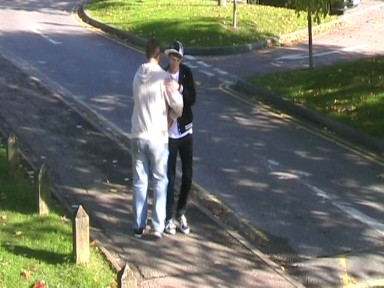
In this shot, we tried to create our own DIY crane shot, with the help of a small outbuilding on the school grounds. We felt that this shot made a good transition from the previous shot (a long shot from the other side), and it also created a sense of the character HB being constantly watched, as he is a very sought after rapper. In the editing stage I decided to fade this shot into the next close up of me in the studio as I thought the video needed a wide variety of shot transitions instead of just straight cuts.

We used this shot as a recurring image throughout the video. We thought it added another dimension to the artists profile (not only are the audience seeing him in an urban environment, they now see him in a studio environment). This idea was inspired by the studio shots used in The Games' 'Dreams' video (photo below) which I have previously included in this blog (Below).

Friday, 26 November 2010
HB-'Never Let The Party Stop'-Final Video
this is the final version of our music video.
We have fixed our minor problems with the lip syncing and are very happy with the end product.
Thursday, 25 November 2010
Evidence of Editing
This video shows us editing the faulty lip syncing which was the main problem in our rough cut video.
Wednesday, 24 November 2010
Rough Cut Video Facebook & Peer Feedback

This is the feedback I received when I posted the rough cut on Facebook. Feedback has been generally positive, with much of the audience especially liking the final scene. Some comments have been made about the lip syncing being slightly out in some places, which we were aware of. We hope to have the final video completed with the lip syncing fixed.
During class my peers viewed my video and gave me feedback. Some of their feedback included:
Positives
-Steady shots
-Good transitions/editing
-Good variety of editing techniques
-Good variety of shot types
-Well lip synced
Negatives
-Lighting sometimes not ideal
-Lips sometimes out of frame
Monday, 22 November 2010
ROUGH CUT VIDEO
This is the rough cut of the video. At the moment, we are happy with the majority of the shots, be it location and syncing. The main problem is that we aren't happy with some of the lip syncing as it is slightly out of time. We will hopefully have the final cut of the video up by the end of this week.
Saturday, 20 November 2010
CALL SHEET
FILMING DAY 1-PRACTICE
ALL- Report to Garden City Park for mise-en-scene photography and filming. Duration: 1 hour(s)
FILMING DAY 2-MAIN FILMING
David, Jack and Sam-Report to School at 10am for opening shot filmings and progression filmings.
Jenni-Report to Davids house at 12pm with car. All proceed to City Centre.
ALL-Film at Middle Class estate.
FILMING DAY 3-CLUB SCENE
ALL (INCLUDING EXTRAS)-Report to Drama Room at 3pm for club filming.
NOTE: CLUB SCENE CANCELLED DUE TO LACK OF ATTENDANCE, CHANGED TO BACKSTAGE SCENE
FILMING DAY 4-BACKSTAGE SCENES
ALL(INCLUDING ED)-Report to Backstage area for final filming.
ALL-Report to Media room for lip and studio filming.
ALL- Report to Garden City Park for mise-en-scene photography and filming. Duration: 1 hour(s)
FILMING DAY 2-MAIN FILMING
David, Jack and Sam-Report to School at 10am for opening shot filmings and progression filmings.
Jenni-Report to Davids house at 12pm with car. All proceed to City Centre.
ALL-Film at Middle Class estate.
FILMING DAY 3-CLUB SCENE
ALL (INCLUDING EXTRAS)-Report to Drama Room at 3pm for club filming.
NOTE: CLUB SCENE CANCELLED DUE TO LACK OF ATTENDANCE, CHANGED TO BACKSTAGE SCENE
FILMING DAY 4-BACKSTAGE SCENES
ALL(INCLUDING ED)-Report to Backstage area for final filming.
ALL-Report to Media room for lip and studio filming.
Friday, 19 November 2010
Film Change
We were scheduled to film a club scene for the video yesterday, yet a combination of circumstances meant that we had to re-think the whole climax of the video, completely scrapping the club scene idea. The main reasons were-
-We were not able to use the lights in the drama studio, which was part of the appeal of using that room in the first place.
-We had a limited amount of extras, meaning a poor sense of the "club" atmosphere
Instead, we chose to change the climax. We have 'HB' walking through the backstage area of the venue and being met by venue staff and avid fans, before taking his place behind the curtain. We filmed and edited it today, and should have the rough edit and final cut uploaded by next week, staying well within our original plans. We are incredibly happy with how the video is looking so far, and think that the final version will be as good as we could of possibly made it.
-We were not able to use the lights in the drama studio, which was part of the appeal of using that room in the first place.
-We had a limited amount of extras, meaning a poor sense of the "club" atmosphere
Instead, we chose to change the climax. We have 'HB' walking through the backstage area of the venue and being met by venue staff and avid fans, before taking his place behind the curtain. We filmed and edited it today, and should have the rough edit and final cut uploaded by next week, staying well within our original plans. We are incredibly happy with how the video is looking so far, and think that the final version will be as good as we could of possibly made it.
Timeline and Sholist


I made this timeline/call sheet so that I could keep track of our progression whilst making the video, and it also helped me in the research and planning stages as I could see clearly what we needed for the video and could then think of how this could be achieved.
Monday, 15 November 2010
Target Audience
We have analyzed the content of the lyrics and the hip hop genre as a whole in order to determine our target audience. We believe that our products target audience is 15 to 30 year old men and women, which in the music business, is a mass audience and key to many artists success.
Where as hip hop used to be a very limited genre, mainly associated with "thugs", in recent years it has erupted into the music mainstream, with artists like Jay-Z and Eminem having number 1 hits across the world. This leads us to believe that our hip hop music video is aimed at one of the most important and broad mass audiences in the music business today.
We believe that our CD cover will appeal to the target audience as it is very simple and distinct. We made it black and white as this design is heavily used by famous rapper Jay-Z (Check earlier post on the blog). We would hope for our CD to be sold in chain music stores like HMV in order to reach as wider audience as possible, as well as iTunes, due to the increase in online downloads. Our video will appeal to our mass audience as it is depicting an experience from the stars perspective. This allows the audience to feel as if they are alongside the star, and generally closer to him. We would hope to have our video on both Major (MTV) and "Indie" (AKA) music channels. Our advert fits in with the conventions of rap and club music, with the club scene in the background. We hope it would be seen in major music magazines such as NME and Q, as well as Hip Hop based magazines such as Vibe and Source.
This is a mind map of my ideas for our target audience.

Where as hip hop used to be a very limited genre, mainly associated with "thugs", in recent years it has erupted into the music mainstream, with artists like Jay-Z and Eminem having number 1 hits across the world. This leads us to believe that our hip hop music video is aimed at one of the most important and broad mass audiences in the music business today.
We believe that our CD cover will appeal to the target audience as it is very simple and distinct. We made it black and white as this design is heavily used by famous rapper Jay-Z (Check earlier post on the blog). We would hope for our CD to be sold in chain music stores like HMV in order to reach as wider audience as possible, as well as iTunes, due to the increase in online downloads. Our video will appeal to our mass audience as it is depicting an experience from the stars perspective. This allows the audience to feel as if they are alongside the star, and generally closer to him. We would hope to have our video on both Major (MTV) and "Indie" (AKA) music channels. Our advert fits in with the conventions of rap and club music, with the club scene in the background. We hope it would be seen in major music magazines such as NME and Q, as well as Hip Hop based magazines such as Vibe and Source.
This is a mind map of my ideas for our target audience.

Saturday, 13 November 2010
Amateur vs Professional
Amateur Video or 'What I Go To School For' by Busted.
Professional Video for 'What I Go To School For' by Busted.
Busted were one of the most popular boybands of the decade, meaning it would be very difficult for amateurs to emulate the success and professionalism of their videos. The video I have found, a take on their video for the song 'What I Go To School For', was one of the best and most accurate remakes I could find on Youtube. it is normally very difficult for students to recreate a video so well, but this group have done a great job.
The mise-en-scene is very similar in both videos. The amateur video has more light in their video as they have no real control over the light (Most of their light is simply sunlight. This is different to the professional video who used combinations of dark and bright light throughout the video. The clothing is very similar in both videos, with the professional video being slightly more extravert. The professional video's costumes are more exaggerated as they want their audience to understand that it is set in a school, even if it is slightly unrealistic. The amateur video has very subtle school clothing as they used their actual school uniform! The professional has a very detailed narrative which works very effectively in the video. The amateur video tries to follow the same narrative and do so quite well.
The editing in the professional video is generally very quick, with generally quick edits and minimal fades. The amateur video is very similar, with the edits not being quite so erratic. Both videos are put together very well, with continuity being kept throughout. There are numerous camera shots used in both videos, including Panning, Over The Shoulder, Close Up, Extreme Close Up and Handheld Shots. The amateur video has the majority of the shots that the professional video does although some lack in professionalism. In almost all of the Professional shots, it is clear a tripod or another device has been used to steady the camera. In the amateur video this is also present, yet some handheld shots are far unsteadier than the professional shots.
The sound is very well linked with the visuals in both videos. The lip syncing in the Professional video is virtually perfect. The syncing in the amateur video is of a very high standards, yet sometimes unclear as the characters do not exaggerate their mouths movements, making it difficult to link with the lyrics. Overall, the amateur video does a very good job of emulating the professional video, with some elements being ever so slightly different, mainly due to the lack of funding and equipment that is used in the professional video.
Professional Video for 'What I Go To School For' by Busted.
Busted were one of the most popular boybands of the decade, meaning it would be very difficult for amateurs to emulate the success and professionalism of their videos. The video I have found, a take on their video for the song 'What I Go To School For', was one of the best and most accurate remakes I could find on Youtube. it is normally very difficult for students to recreate a video so well, but this group have done a great job.
The mise-en-scene is very similar in both videos. The amateur video has more light in their video as they have no real control over the light (Most of their light is simply sunlight. This is different to the professional video who used combinations of dark and bright light throughout the video. The clothing is very similar in both videos, with the professional video being slightly more extravert. The professional video's costumes are more exaggerated as they want their audience to understand that it is set in a school, even if it is slightly unrealistic. The amateur video has very subtle school clothing as they used their actual school uniform! The professional has a very detailed narrative which works very effectively in the video. The amateur video tries to follow the same narrative and do so quite well.
The editing in the professional video is generally very quick, with generally quick edits and minimal fades. The amateur video is very similar, with the edits not being quite so erratic. Both videos are put together very well, with continuity being kept throughout. There are numerous camera shots used in both videos, including Panning, Over The Shoulder, Close Up, Extreme Close Up and Handheld Shots. The amateur video has the majority of the shots that the professional video does although some lack in professionalism. In almost all of the Professional shots, it is clear a tripod or another device has been used to steady the camera. In the amateur video this is also present, yet some handheld shots are far unsteadier than the professional shots.
The sound is very well linked with the visuals in both videos. The lip syncing in the Professional video is virtually perfect. The syncing in the amateur video is of a very high standards, yet sometimes unclear as the characters do not exaggerate their mouths movements, making it difficult to link with the lyrics. Overall, the amateur video does a very good job of emulating the professional video, with some elements being ever so slightly different, mainly due to the lack of funding and equipment that is used in the professional video.
Friday, 12 November 2010
Editing Progress
We have now edited 2 minutes and 14 seconds of our film, with the rest being filmed on the 18th of November. We are very proud of our work, with myself taking control of the editing, with great help from David and Sam. Whilst myself and David focused on the main bulk of the editing task, Sam and Jenni then filmed the "lips" sequence from various angles as an extreme close up. This is a very important shot as it is a recurring image throughout the video.
Myself and David, with help from Sam and Jenni, spent roughly 3 to 4 hours editing our current video, and we are incredibly happy with the result. As we only have one scene left to film, we are all focusing on the mise-en-scene and camera shots to ensure that we get everything we need to make the climax as good as possible.
Myself and David, with help from Sam and Jenni, spent roughly 3 to 4 hours editing our current video, and we are incredibly happy with the result. As we only have one scene left to film, we are all focusing on the mise-en-scene and camera shots to ensure that we get everything we need to make the climax as good as possible.
Tuesday, 9 November 2010
Progress
Having done the majority of our filming (everything apart from the climactic club scene), we have begun editing the piece. So far we are very pleased with it, having currently edited 1 minute and 41 seconds of the 3 minute long song.
We have included many different shot types, and have even began to vary in cuts between shots, using both quick edits and fades. We hope to continue with this progress and have all of our current piece edited before we shoot the club scene, making the final editing process simpler.
We have included many different shot types, and have even began to vary in cuts between shots, using both quick edits and fades. We hope to continue with this progress and have all of our current piece edited before we shoot the club scene, making the final editing process simpler.
Subscribe to:
Posts (Atom)